

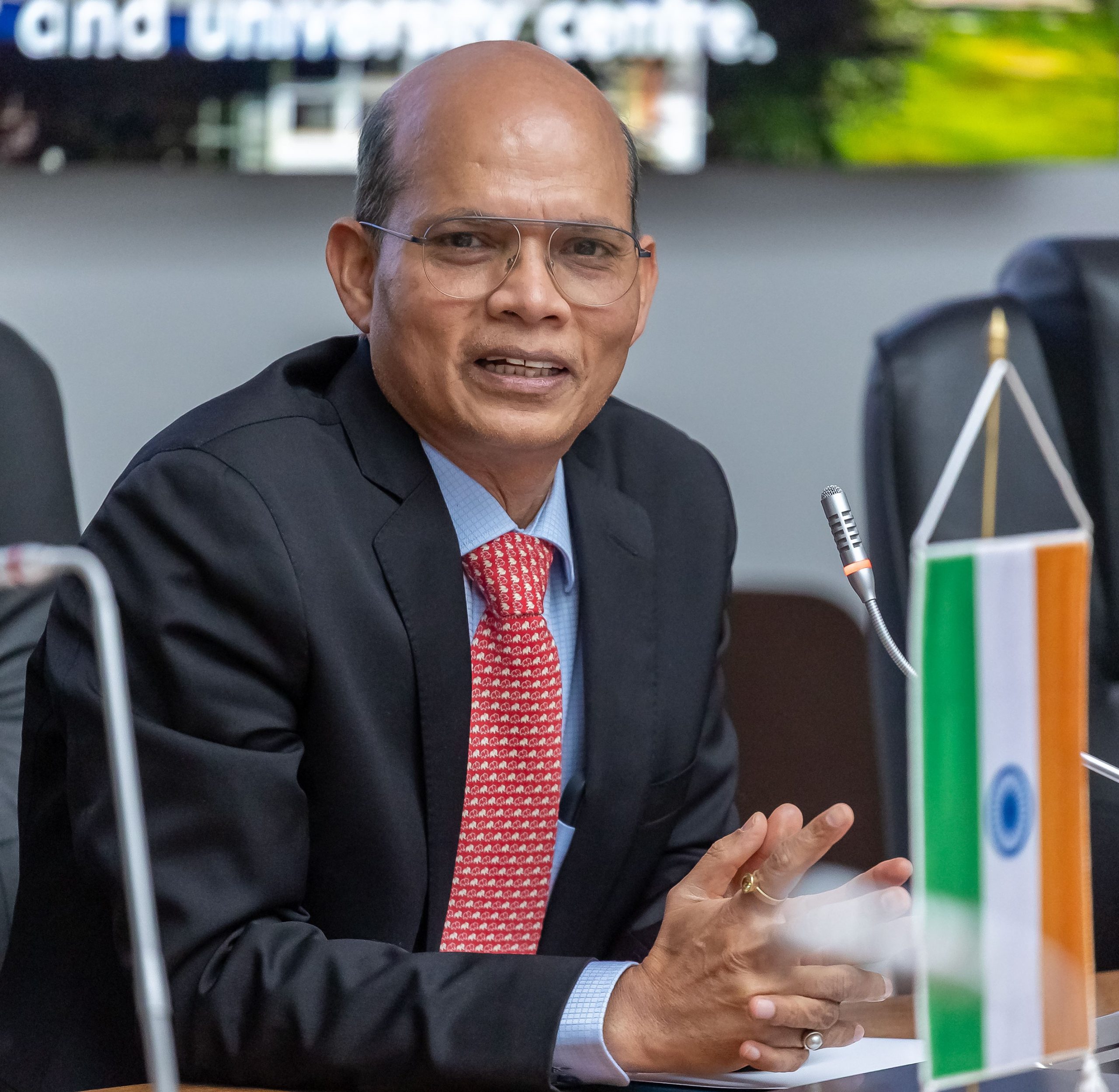
HE, Mr. Manoj Kumar Mohapatra, Ambassador of India: “Accelerated Cooperation: India and Romania Define Six Pillars of Economic Development”
HE, Mr. Manoj Kumar Mohapatra, Ambassador of India:
„Trade and economic relations between India and Romania are on an upward trajectory!
Given this, beyond the ongoing improvements, another piece of good news is that India’s economy has grown by 8.2% over the past three months. As India’s economy continues to expand at this pace, we see strong potential for India and Romania to collaborate further and strengthen their bilateral relationship, particularly in the economic and commercial fields.
During the visit, both Romanian and Indian stakeholders identified pathways for future collaboration and cooperation. I would say that we have identified six key areas of cooperation. Indians generally move fast, so we coined the term ‘SPEED’.
SPEED means moving very quickly. What does it stand for? I would say it is S-P-E-E-D, with an additional ‘D’ that I have included. These represent the six areas, or pillars, of cooperation we are focusing on.
Starting with S, which stands for supply chain management. This means that we would like Romania to serve as our gateway to Europe, particularly to European Union countries.
P stands for pharmaceuticals. As you know, during the pandemic, India supplied vaccines produced domestically to more than 150 countries, along with essential medicines—hence India is often referred to as the ‘pharmacy of the world’. We would be very pleased to collaborate on the production of medicines and vaccines here in Romania. A strong example is Terapia S.A., where thousands of Romanians are employed.
The next E stands for energy. India is currently advancing rapidly in renewable energy, and we see significant opportunities—especially in this sector—to cooperate with Romania. We have already discussed bilateral cooperation in this field with the Minister of Energy.
Another important area is education. Over 1.4 million Indian students are studying abroad, and Romania remains largely unexplored in this regard. Considering Romania’s advantages—such as safety, lower tuition fees, English-taught programs, and EU-wide recognition of diplomas—we would be very pleased to see more Indian students coming here. Educational cooperation could include faculty exchanges, student mobility, and joint research initiatives.
D stands for digital. Currently, between 10,000 and 14,000 Romanians are employed by Indian IT companies such as Wipro, Genpact, and Tata Consultancy Services (TCS). We would be very interested in expanding cooperation in areas such as artificial intelligence and data analytics—not only for Romania, but also for other European markets.
The final important area is defence. India has demonstrated strong capabilities in the defence sector, and we are already engaged in Romania in the production of drones, RDX, and other defence equipment. We would like to continue and expand this cooperation.
Regarding bilateral trade between India and Romania, 2023 marked a peak, exceeding USD 3 billion, although it later declined to around USD 1.4–1.5 billion. According to estimated data, there are approximately 560 Indian companies with a direct presence here, along with another 400–500 companies registered elsewhere but operating in Romania. This means that around 1,000 Indian companies are active in Romania, across sectors such as agriculture, real estate, energy, and digital.
This makes us proud, as Indian companies have successfully entered the Romanian market and invested here. For example, in Brașov, I saw the Indian flag flying at Harsha Engineers Europe S.R.L., one of the largest Indian investments in Romania, employing over 200 people. Similarly, Terapia S.A. produces more than 400 medicines and employs over 1,000 people, while the German company Boss, registered in India, employs more than 4,000 people in Romania.
Thus, although India and Romania are geographically distant, we remain active partners and have identified key areas for cooperation. This marks a new phase, and we would be pleased to continue building on it.
In conclusion, I would once again like to express my sincere gratitude and appreciation to all members of RIZ.
Thank you very much.”*


